Over the past year, we have seen many issues come center stage in the presidential campaign -- including health care, immigration, and women's rights -- but there is still one topic that keeps returning to the headlines: public sector employment and their unions.
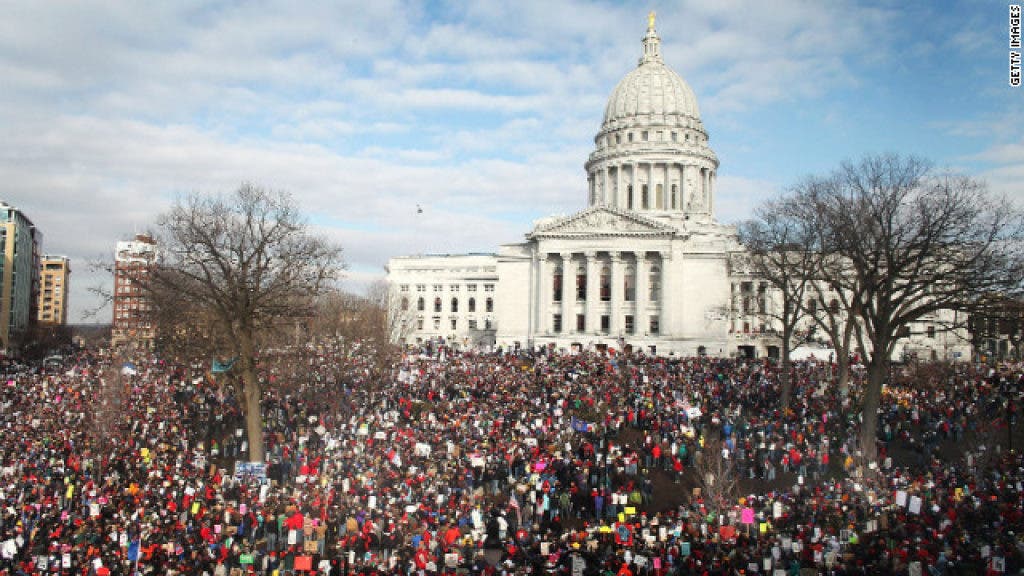
The scene was set in Wisconsin: the June 2012 gubernatorial recall election. The months leading up the June 5th special election were flooded with harsh campaigns ads from both sides. Millions of dollars were spent on each side of the battle between Governor Scott Walker trying to hold onto his seat and Milwaukee Mayor Tom Barrett, Walker’s same opponent from the original race during the 2010 midterm election. (However, a lot more of the money for Walker came from outside of the state and from a few wealthy guys giving generous donations. But that's another story.) The reason the recall even happened at all was because of the public sector unions. In order to improve the economic situation in his state, Walker made drastic cuts to the education budget and had an agenda to end collective bargaining rights for state workers.
This caused much uproar with huge protests around the state, including many at the capitol. What made it such a popular race to observe -- probably considered the most important election of the year after the presidential one -- is that it pitted the unions and (most) middle class workers against corporate America. Walker was only able to win for two reasons: 1. He had a lot of money available to him; and, and more importantly 2. He was able to make his opponent seem to be solely backed by the unions, as a union candidate rather than a Democratic candidate. But the problem with that is that many unions are misunderstood and misrepresented.
Organized unions have been acquiring a bad reputation ever since Senator McCarthy's Red Scare in the 1950s. Even though they have changed (mostly for the better) since then, unions are generalized as communist, power-hungry groups which only care about themselves and not the company or place where they are employed. Even if it might have once been the slightest bit true, that is certainly not the case anymore. Keep in mind: public sector workers (i.e. policemen, firefighters, teachers, etc.) mostly unionize to get fair wages and protect their rights.
Let's take an imaginary visit to a local school, and look in on a teacher's classroom. With economic downturn (though the economy is slowly improving) still hitting local and state budgets, many unfair and severe cuts have been made to the education costs for municipalities and individual schools. Funding for extracurricular programs, like the theater and arts, sports, and clubs, has all but vanished. If there are any programs left, they often don't receive funding from the school. Resources are so scarce that it has come down to many teachers to purchase classroom supplies with their own money.
So in this local school, in the teacher's classroom, we see pencils and other items that the teacher bought with her (or his) own money to make sure they are available to all their students. We're cutting school budgets to help solve the problem, but part of the problem to begin with is the lack of a sufficient education. If students are provided an opportunity to learn and have the materials they need to succeed, then they are more likely to be successful throughout their academic career and in the workplace. But, for now, teachers are paying for many of their classroom supplies and, because of that, they have less to spend on groceries and in other private sector businesses. So, if public sector employees lose their benefits and have cuts to their budgets (police and firefighters included), they are less likely to be willing to spend their hard-earned money unless it is something they actually need. They have money, but they are just more cautious in their purchases.
It should be obvious that there are still many tough budget decisions to be made in households, in schools, and in many other places. We all do and believe in what each of us think is best. Whether it's providing the best education possible to our children, or keeping our families safe and protecting us from criminals, or stopping our houses from burning down (to name a few), public sector employees always do what is in the best interest of our communities and country, not what is best for corporate America. So, please, think twice before condemning public sector employees. Sure they are paid with our tax dollars, but they realize and appreciate that and do all they can to make sure public monies are spent wisely.
Representative Henry Waxman of California, the top Democrat on the Energy committee, said the U.S. needed to continue to invest in alternative energy. “Our economic growth and our national security will be determined by whether we succeed in building these new industries,” Waxman said. Representative Diana DeGette, a Colorado Democrat, said Republicans were using Solyndra to fire “partisan broadsides” at the Obama administration. Warning Signs Among signs Republicans cited as warning flags was an e- mail written by an Energy Department official in August 2009 noting that a model showed a Solyndra project financed with the loan guarantee would run out of money in September 2011. Solyndra filed for bankruptcy on Sept. 6, 2011.
Please consider the full meaning of what I've been saying about the ecosystem-like industrial commons that used to function to make us not only the richest country but the most inventive, the most technologically advanced and most R&D-oriented society in the world. Even when we had no global competitors yet, in the mid 1960s, we were spending more of our GDP on R&D than now --now as our ranking in educational achievement and science and engineering degrees is plummeting, as our industries are challenged by literally dozens of economic competitors beating us in virtually any sector of tradeable goods and services, not to mention quality of life in terms of real wages and conditions of labor and infrastructure and health. The point is unions really ARE at the bottom of the list of why offshoring is happening.
tires, asphalt, crayons, paper cups, wax paper. As for climate change, I'll bet you don't even know what the largest greenhouse gas is in the atmosphere (hint: it's not CO2, not by a longshot). Since you'll just Google the answer anyhow, I'll save you the trouble: It's water vapor.
Washington is doing none of this, but only spending more and asking for increases in the debt limit so we can borrow more from other countries to pay for all this fiscally-irresponsible spending.
1) lack of significant govt incentives to build factories and R&D centers: free land, construction and wage subsidies, tax abatements, low interest loans, etc (corporate welfare perhaps, but rewarded with essential centers of wealth creation and innovation). 2) Lack of govt guarantees of stable raw material prices: volatility too risky, they move where govts guarantee stable feedstock prices.
4) US losing arms race in providing R&D tax credits, now #17 on the list. Compounded by uncertainty: US R&D tax credits always temporary, thus unpredictable while foreign are perm and predictable. 5) US losing arms race to wise regulation. Muddled and state-by-state US regulations full of contradictions and prescriptions rather than final goals as criteria for compliance. "Sometimes markets fail to place monetary value on things we as a society value in a real way --clean air and water, product and workplace safety, justice and fairness. When regulations are too lax, bad things result." But we need SMART and consistent and predictable regulation, coordinated across all departments and agencies, focused around clear goals. 6) Lack of free and fair trade with our trading partners: our markets are much more open than most Asian and Euro markets, not enough free trade treaties since our trade deficits are with countries where we lack free trade treaties and thus our industries are locked out of markets and subject to unfair competition.
"It isn't what you think, in general its a mistake to think mfg is leaving chiefly due to labor costs, since US productivity so higher. If cheap labor were root then mfg would be in Honduras and Haiti and Burundi and Sierra Leone. Other high wage countries offer other incentives [see #1-6 above --WW]. Other countries offer better total packages of incentives to make them more predictable and profitable."
12:17 pm on Tuesday, September 4, 2012 When will you DEMS learn that you cant spend more money than you have. Excellent point. I always knew George WMD Bush, supported 100% by Pinocchio Ryan, was a secret DEM when he put two wars, two tax cuts, and a prescription drug plan on the national credit card.
You can treat capital “poorly”, as the US does currently, and watch it go elsewhere. Or you can treat capital wisely and watch it accumulate here. What you CAN’T do is treat capital poorly here AND watch it accumulate here. A very basic dynamic lost on the propeller heads in DC and Hartford. But, politicians being the sociopaths that they generally are will try to have it both ways. They will treat capital poorly AND prevent it from leaving. That’s when you will see capital/currency controls enacted. Look to Argentina’s policies for the future here.
http://www.youtube.com/watch?v=R5ZvQsP48pQ&feature=youtu.be
Keep those eyes fixed on the bouncing GOP ball, Day. It's what they want - that way you don't have to see the reality of what you support.
I find that those who are least impacted by the economy are the most supportive of this approach to vilifying those with money. All I have to say to these people is walk a day in my shoes or in the shoes of someone who has worked as a professional, lost that job due to this downturn, and now struggling to attain a new full time job.
They mindlessly cling to the phony propaganda they have been indoctrinated with, that "Utopia" can be achieved if we just have MORE Government! These willfully blind tools of the statists, like Obama, believe that the Constitution, which LIMITS the powers of government, should be ignored now. That the Laws of God and Nature's God should also be ignored, not to mention 'the Law of the Harvest," that people reap what they sow. Liberals are against "Personal Responsibility," Limited Government, and the Free Enterprise system upon which our nation was founded. In short, they want our nation to go down the FAILED road of Bankruptcy of the European "Nanny State" cradle-to-grave "entitlements" societies, such as Greece, Spain, Portgugal etc. (I know that you know all that, Ed--but I am summarizing for those who have not been paying attention, or have been deceived by the anti-American schemes of those who sound like they "care" more for the poor.)